

Sorted by category:
Models and Sensor Data
2026-05-06
Foundation Models for Physics
AI has rapidly found its way into our daily lives. We use it for coding, for writing texts, for generating images and much more. But until recently, the development of AI for applications in the physical world was a bit lagging. Now, foundation models and world models promise to lower that barrier.
Read more

2025-11-13
Forecasting urban flooding with machine learning
Can we reliably forecast and manage urban flooding with a machine learning model? That was a question that was raised at Deltares, a knowledge institute for water and the subsurface. Initial research was promising. As VORtech is building up its expertise in machine learning for physics-based modelling, we welcomed the opportunity to join Deltares and Delft University of Technology in further explorations.
Read more
2017-10-13
Models and sensor data: a powerful combination
Models and sensor data are an indispensible combination. Sensor data is needed to validate models and the models are often necessary to understand and extrapolate the data. VORtech has been working a two very exciting projects in the past few months in which sensor data and models are combined in an innovative application.
Read more
2017-08-11
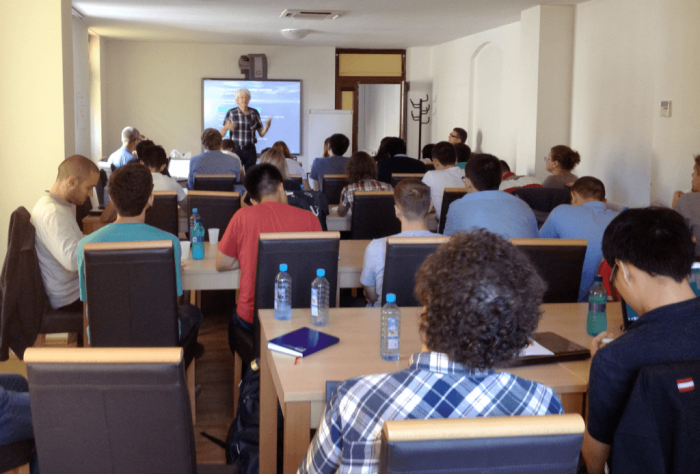
Summer School: Data Assimilation
The Summer school "Data Assimilation and its Applications in Oceanography, Hydrology, Risk & Safety and Reservoir Engineering" in Sibiu, Romania.
Read more
2017-02-14
Meetup Data Science in Industry
On Thursday February 23, 2017, VORtech hosted our first Meetup on Data Science: "Data Science in Industry"
Read more
2014-10-17
Obtaining optimal settings for groundwater flow models
Groundwater flow models require proper setting of parameters. Obtaining optimal settings based on measurement by using the OpenDA data-assimilation tool.
Read more