

Physics AI: a powerful combination of machine learning and physics
Many of our clients are working on software for forecasting or simulating natural processes such as the flow of water and the processes in industrial installations. Given the rapid developments in AI, an obvious question is whether it is also suitable for these calculations with a physics background. The answer is: yes, but…
Opportunities in the AI economy
Before we delve into the details of Physics AI, it’s good to emphasize that these types of applications offer excellent opportunities in an economy where AI plays a significant role.
A recent report aptly pointed out that the amount of data for training language models is finite and is almost entirely used already. Measurement data, on the other hand, is not finite: terabytes of measurement data are generated every day. This means that there is a huge opportunity to put this data to good use with machine learning. The Netherlands can distinguish itself by building applications on the kind of data that is unique to our country, such as from agriculture, horticulture or civil engineering.
How do you want to use this?
We are exploring how we can best support our clients in using Physics AI. Help us in this exploration by completing the short survey now. From the participants, we’ll randomly choose five that will get a book voucher worth € 25.
Learning with natural science
Measurement data is quite different from the text data that is used to train language models. Measurement data is often multidimensional (for example, it also contains the coordinates of the measuring point in addition to the measured value itself), it can contain various types of errors (for example, due to incorrect calibration of the measuring device), and measurement accuracy is an important aspect.
Also, sensors can usually only observe a relatively small part of a process, making the context incomplete. All this means that training AI with measurement data is not the same as training language models.
Moreover, models with an application in physical reality have a low tolerance for the hallucinations known from language models. Reliability is essential if you want to use the AI model to control a device or to develop environmental policies.
But these difficulties are offset by a major advantage: we know at least part of the underlying physical processes that generate this data. By incorporating this knowledge, we can still use measurement data to develop AI models that are reliable enough for application in the physical world.
Use Cases
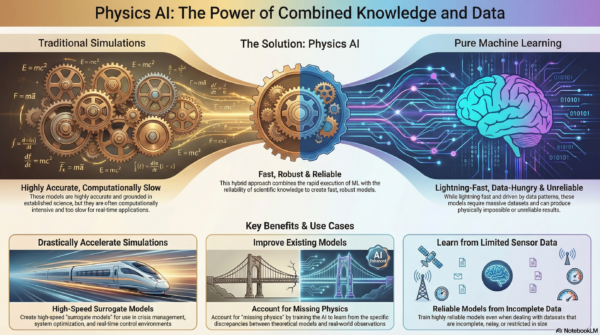
The technology for training machine learning models that respect the laws of physics is now being marketed under the somewhat dubious but concise term “Physics AI”. Essentially, three use cases are important to our clients:
- Developing fast surrogate models based on machine learning. A machine learning model can generate answers very quickly where traditional models can require hours of calculation. Such a machine learning model can then serve as a stand-in or surrogate for the traditional model, for example, in optimization calculations.
- Modelling the differences between measurements and (traditional) models. Every model only approximates reality, and some physics is usually deliberately omitted. For example, because the missing physics cannot be modelled effectively. In that case, a machine learning model can be trained to incorporate those missing physics.
- Developing models based on sensor data. By using Physics AI techniques, reliable AI models can be generated, even with sensor data that is far from perfect.
You can read more about this in our recent white paper on this topic.
The Technology
There are many ways to use physics knowledge in machine learning. For example, additional (synthetic) training data can be generated with traditional models. Or compliance with the laws of physics can be used to reward the AI model during training. The vibrant field of scientific machine learning is rapidly developing new techniques, and the number of papers published on the subject is almost impossible to keep up with.
At VORtech, we are working hard to build competence in the field of Physics AI. Through internal research, we are identifying which techniques are suitable for which applications and what the pitfalls are. A nice demonstration of work that we did is a surrogate model for a conveyor belt. Another example is the internship project we conducted with the research institute Deltares on predicting overflow during heavy rainfall.
How do you want to use this?
We are exploring how we can best support our clients in using Physics AI. Help us in this exploration by completing the short survey now. From the participants, we’ll randomly choose five that will get a book voucher worth € 25.
Want to know more?
If you’d like to know what Physics AI can do for your application, please don’t hesitate to contact us. We’d love to talk to anyone interested, also to learn more about market needs. You can reach us via the contact form on our website or by calling us at +31 15 285 01 25.