

VORtech Blog
2026-03-11
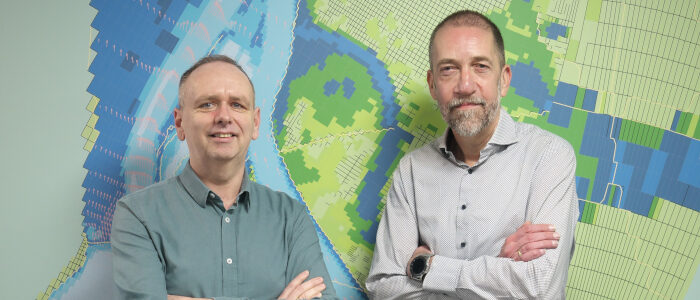
A new director at VORtech
Effective May 1st, Jeroen Gerrits will be the new director of VORtech. After 30 years, the current director Mark Roest is stepping down. In this joint interview, Mark and Jeroen discuss this change.
Read more

2026-03-11
VORtech sponsors the DCSE MSc Thesis Award
This year, the TU Delft Institute for Computational Science and Engineering (DCSE) will award a prize for the best MSc-thesis in the field for the first time. VORtech is the proud sponsor of this prize.
Read more

2026-03-11
Physics AI: a powerful combination of machine learning and physics
Many of our clients are working on software for forecasting or simulating natural processes such as the flow of water and the processes in industrial installations. Given the rapid developments in AI, an obvious question is whether it is also suitable for these calculations with a physics background. The answer is: yes, but…
Read more

2026-03-11
Major changes in computational software
Our anniversary symposium on April 9th in Delft will discuss the big changes in our field. This blog post offers a preview.
Read more
2026-03-02
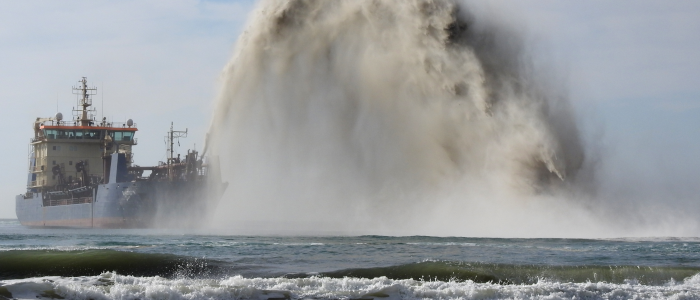
How Mathematics made a Calculation Model feasible
This is the second blog in our series where we show that our mathematical strengths are an important complement to our programming skills. Using a mathematical approach, we achieve solutions that programming alone couldn't. This time, we speak with Thea, who, along with Bas and then-colleague Alouette, worked on a fantastic project for Boskalis. Their mathematical insights led to a tremendous reduction in computing time, making a previously unusable computation feasible.
Read more

2025-12-22
Our vision on AI-assisted programming
Tools like GitHub Copilot, ChatGPT based code assistants, and similar systems have quickly found their way into the daily workflow of software engineers. These assistants represent a significant shift in how we build software. They blend machine learning with long established software engineering practices in a way that is now mature enough for real use in industry.
Read more

2025-12-22
Surrogate models for model-in-the-loop control
Complex numerical simulations can be accelerated by training so-called surrogate models using machine learning. Such models give an approximation of the full model but with significantly lower computation times. It enables the use of the model in online control (model-in-the-loop) and allows interactive use and more extensive parameter studies.
Read more
2025-12-10
Tech Stack for Machine Learning
Machine learning projects aren't just about developing models. Equally important are the infrastructure and supporting tools that ensure repeatable experiments, well-managed data, and reliable reproduction of results. Based on our experience, we recommend TensorFlow as a framework, MLflow for experiment tracking, and proper data management with DVC (Data Version Control).
Read more

2025-11-13
Forecasting urban flooding with machine learning
Can we reliably forecast and manage urban flooding with a machine learning model? That was a question that was raised at Deltares, a knowledge institute for water and the subsurface. Initial research was promising. As VORtech is building up its expertise in machine learning for physics-based modelling, we welcomed the opportunity to join Deltares and Delft University of Technology in further explorations.
Read more

2025-11-11
Mathematics for fast processing of genetic data
In this blog series, we demonstrate that our mathematical strengths are an important complement to our programming skills. Using a mathematical approach, we achieve solutions that programming alone wouldn't. The blogs are based on interviews with colleagues who recently completed projects where mathematics played a decisive role. In this first post, we speak with Maarten, who conducted a fascinating project for Wageningen University & Research (WUR). He worked on efficiently storing and processing a vast amount of genetic data
Read more